ENES

The Chicago 'L': lines, stations, fares and times

Eight colour-coded lines, 144 stations and two of them running 24 hours a day. Everything here is built from the CTA's own published data — and kept honest about what has changed.

Service monitoring

Chicago 'L' status

Service status · updated in real time

Red

95th/Dan Ryan ↔ Howard

Normal service
OK
Blue

Forest Park ↔ O'Hare

Normal service
OK
Brown

Kimball ↔ the Loop

Normal service
OK
Green

Harlem/Lake ↔ Ashland/63rd + Cottage Grove

Normal service
OK
Orange

Midway ↔ the Loop

Normal service
OK
Purple

Linden ↔ Howard (Express to the Loop at rush)

Normal service
OK
Pink

54th/Cermak ↔ the Loop

Normal service
OK
Yellow

Dempster-Skokie ↔ Howard

Normal service
OK
Normal serviceMinor delaysService suspendedOutside service hours
🚇
Before every trip, check the 'L' statusSave this page to your favourites and check it to travel informed: you’ll see at a glance if any line has issues.
View service status

8

colour-coded lines

143

stations open today

2

lines run 24 hours

$2.50

any ride, any distance

Riding the 'L' for the first time?

Chicago’s rapid transit system is known simply as the ‘L’ — short for “elevated”, though a good stretch of it runs in subway tunnels and along embankments too. It opened in 1892 and today it is one of the oldest and largest rapid transit networks in the world, with 8 lines, 143 stations in service and around 421,346 rides on an average weekday.

Three things make it unusual, and they are the three things worth knowing before your first trip:

  • Lines are named by color, not by number. Red, Blue, Brown, Green, Orange, Purple, Pink and Yellow. Trains show their color on the front and side.
  • One flat fare. $2.50 takes you anywhere on the network, one stop or the whole line. The single exception is entering at O’Hare, which costs $5.00.
  • The Red and Blue lines never close. They run 24 hours a day, every day of the year — something only a handful of transit lines anywhere in the world do. The other six shut down overnight, roughly 1am to 4am.

The eight lines

Tap a line for its full station list, how often trains run and the first and last train from every stop.

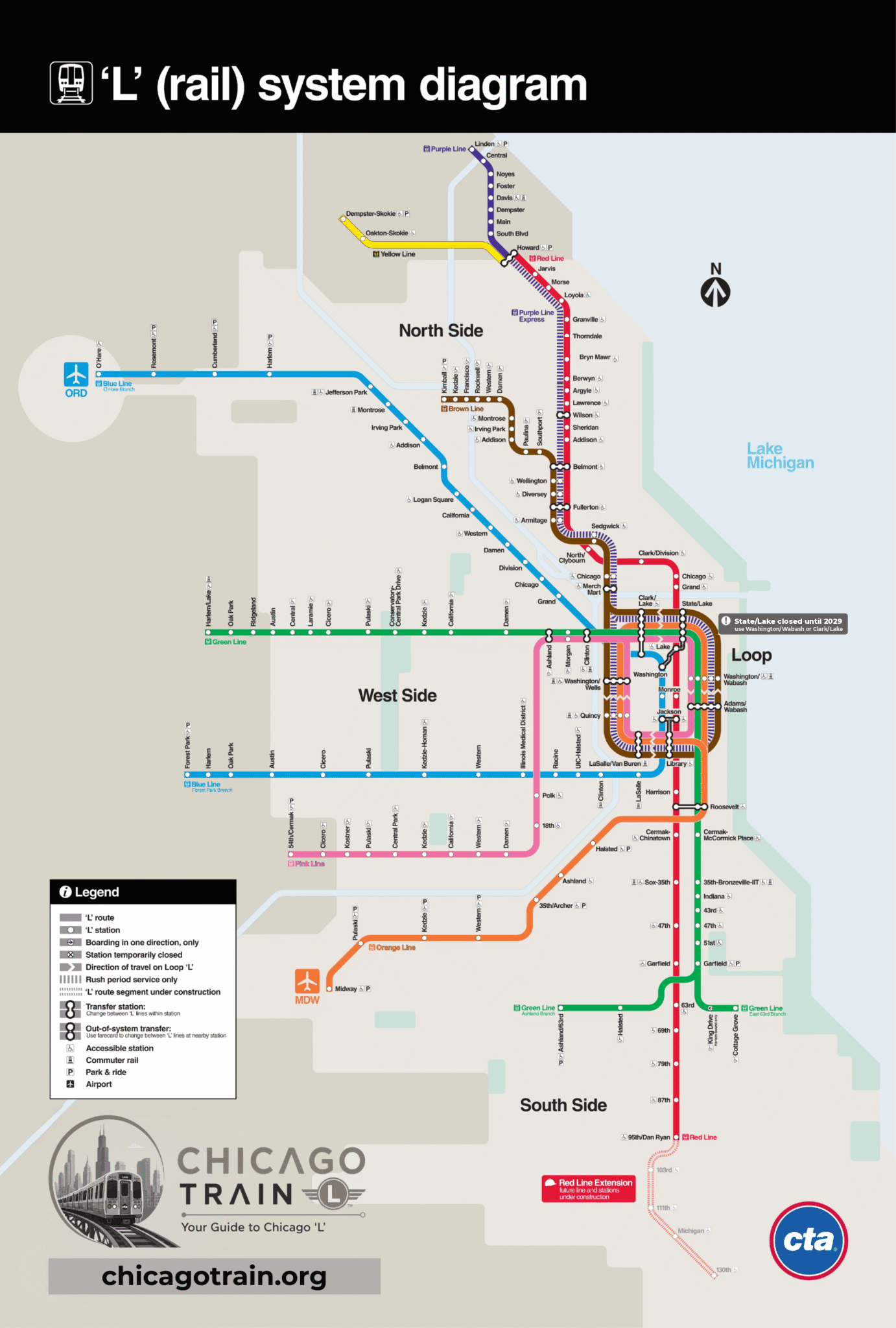
The Chicago 'L' map

The whole network on one diagram. Download it as a PDF and it will still be readable when your phone has no signal underground.

Map of the Chicago 'L' showing all eight lines and every station
The Chicago 'L' rail system diagram · Download the PDF

Work out any journey on the network

Pick two stations and the planner gives you the time, the stops, the changes and what it costs — using the CTA’s real schedule, so it knows the Purple Line Express does not run at lunchtime and that most of the network is shut at 3am.

What it costs

What a ride costs Fares valid July 2026
FareFullReducedStudentNotes
'L' train fare$2.50$1.25$0.75Any journey, any distance
'L' from O'Hare$5.00$1.25$0.75Only when you enter at O'Hare. A pass covers it with nothing extra to pay
Bus fare$2.25$1.10$0.75Ventra or contactless
Bus fare, cash on board$2.50$1.25$0.75Exact change. No transfers
TransferFreeFreeFreeUp to 2 more rides within 2 hours
Unlimited-ride passes Valid on CTA and Pace
PassPriceGood to know
1-Day pass$5Unlimited rides for 24 hours from first tap
3-Day pass$15Sold at Ventra machines at O'Hare and Midway
7-Day pass$20Pays for itself at about 8 rides
30-Day pass$75Reduced fare $35

Source: CTA fare chart. The fare rise announced for 2026 did not go ahead — state transit funding replaced it — so the 'L' fare is still $2.50 and the 3-day pass still exists. Always worth a second look at transitchicago.com before you travel.

Popular trips

Common questions

$2.50 for any journey on the ‘L’, however far you go — one stop or the full length of the Blue Line. The one exception is entering at O’Hare Airport, where the fare is $5.00; leaving from any other station to O’Hare is the normal $2.50.

Transfers are free: once you have paid, you get up to two more rides within two hours at no extra cost. If you are riding more than about twice a day, a 1-Day pass at $5 is already cheaper.

Partly — and this is the thing visitors most often get wrong. The Red Line and the Blue Line run 24 hours a day, every day, including the Blue Line to O’Hare. That makes Chicago one of very few cities in the world with round-the-clock rapid transit.

The other six lines — Brown, Green, Orange, Purple, Pink and Yellow — do close overnight, broadly between about 1am and 4am, with exact times varying by station. Our schedule page lists the first and last train at every stop.

Take the Blue Line. It runs from a station directly beneath Terminal 2 into the Loop, takes about 40 minutes, runs 24 hours a day and costs $5.00 leaving from O’Hare. No booking, no schedule to check — trains come every few minutes most of the day.

From Midway it is the Orange Line, about 25 minutes into the Loop for $2.50. Plan the exact trip.

Ventra is the CTA’s fare system. You have three options and only one of them involves buying anything:

  • Just tap your contactless bank card or phone at the turnstile. Same fare, nothing to buy. This is the simplest option for visitors.
  • A Ventra Card ($5, refunded as $5 of credit if you register it within 90 days) — worth it if you want a pass or travel with others.
  • A single-trip Ventra Ticket from a machine — the most expensive way to ride.

How the Ventra card works, and how to check its balance.

State/Lake, on the Loop elevated, closed on 5 January 2026 and is being rebuilt from scratch as a fully accessible station. It is expected to reopen in 2029. Brown, Green, Orange, Pink and Purple Express trains pass through without stopping — use Washington/Wabash or Clark/Lake instead, both of which are step-free.

Printed maps still showing State/Lake as open, or showing Berwyn and Lawrence as closed, are out of date: those two reopened in July 2025 along with Argyle and Bryn Mawr, and all four are now step-free.

106 of the 143 open stations are step-free, with elevators or ramps to the platform. That is most, but genuinely not all, so it is worth checking before you travel — every station page here says plainly whether it is accessible.

All trains are level with the platform at accessible stations, and every train has priority seating and space for wheelchairs.

On this page